
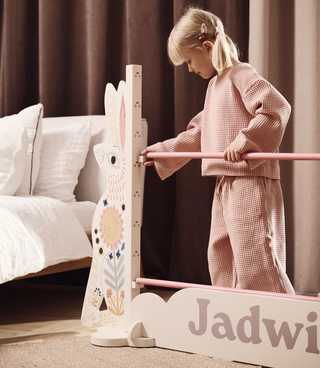
A hobby horse jump is more than a decorated pole. The right model gives a beginner a comfortable place to practise, adapts as confidence grows and fits the space available at home or in the garden. Artwork matters because children want equipment that feels like their own, but practical details decide whether the jump remains useful after the first few sessions.
Before buying, compare the height range, adjustment steps, material, assembled dimensions and the way the pole behaves when knocked. It is also worth thinking about storage and the run-up space needed on both sides. This guide explains each point without relying on rigid age charts.
Start with the space you actually have
Measure more than the width of the jump. A rider needs a clear approach, room to land and enough distance to slow down. Remove loose rugs, toys, pots, furniture and anything else that could catch a foot or the hobby horse stick. Outdoors, choose level ground and check the area for stones, holes and slippery patches.
In a smaller room, one low jump can support plenty of useful exercises. The rider can practise a straight approach, stop before the pole, walk over it and repeat the movement from the other direction. A crowded course is not automatically more interesting, especially when there is no comfortable route around an obstacle.
The Nilchi jump is approximately 100 × 150 cm when assembled. Use those dimensions as a starting point, then add clear space before and after the structure.
Look for gradual height adjustment
An adjustable jump is easier to match to changing confidence and technique than a fixed-height object. A low setting supports first attempts, while additional levels create new challenges without replacing the whole set.
Nilchi hobby horse jumps adjust from 20 to 90 cm in 10 cm steps. That range does not mean that every level is appropriate for every rider. Begin with a height that can be crossed calmly, then observe the approach, take-off and landing. If the rider stops suddenly, loses balance or focuses only on clearing the pole, lower it and rebuild a smooth rhythm.
Read our separate guide to choosing a starting height for a practical progression based on movement rather than age.
Check what happens when the pole is knocked
A pole should not turn a missed jump into a complicated reset. Nilchi obstacles use magnetic holders: the pole rests at the selected height and releases when knocked. It can then be put back quickly, so the next attempt does not require tools or a lengthy adjustment.
This feature is useful during independent play and when several children take turns. It keeps the course easy to understand and reduces interruptions between attempts. Whatever design you choose, read the product instructions and make sure every component is assembled as intended.
Compare material and construction
Material affects appearance, weight, storage and the feel of the product. Nilchi jumps are made from solid pine in a Polish woodworking studio. The wood is finished with lacquer intended for indoor and outdoor use, while original illustrations distinguish the available models.
Wood still needs sensible care. Store the jump according to the supplied guidance and check it before use, particularly after moving it or using it outside. Make sure the base is correctly connected to the upright and that the pole and holders are in their intended positions.
Consider assembly and storage
Ask where the jump will stay between sessions. A product that fits the play area may still need a practical cupboard, wall space or storage corner. The Nilchi set arrives in a parcel approximately 120 × 40 × 15 cm and weighs around 6 kg. Assembly connects the base and upright with one hex screw, following the included instructions.
If the equipment will be moved frequently, plan a clear route and avoid carrying several loose pieces at once. A consistent storage place also makes it easier to check that the set is complete before building a course.
Choose the design after the practical details
Once the height, size and construction fit your needs, the final choice can be personal. Ponny, Bunny, Cloud and Lucky share the same adjustment range, so the illustration can guide the decision without changing the core function.
An optional personalised panel can add a child's name, horse's name or another short inscription. Treat it as a separate decorative choice rather than a substitute for checking the jump specifications.
Browse all wooden hobby horse jumps and compare the artwork on each product page.
A short buying checklist
Before placing an order, confirm that:
- the assembled jump and approach space fit the intended area;
- the lowest settings suit calm first attempts;
- height changes are clear and quick;
- the pole releases and resets in an understandable way;
- the material and care instructions match indoor or outdoor use;
- there is a realistic place to store the set;
- the chosen artwork is the one the rider will enjoy using.
The best first jump is not the tallest or most complex one. It is the model that makes repeated, controlled practice easy and leaves room to create new games as skills develop.